LLM-Driven Penetration Testing Framework User Agent
Detects a user agent that identifies an LLM-driven penetration testing framework. ARTEX, its AntiFox and ScopeWeaver forks, CyberStrikeAI, and HexStrike embed these strings in web requests.
Elastic rule (View on GitHub)
  1[metadata]
  2creation_date = "2026/11/20"
  3integration = [
  4    "apache",
  5    "apache_tomcat",
  6    "anthropic",
  7    "aws",
  8    "azure",
  9    "gcp",
 10    "gcp_vertexai",
 11    "iis",
 12    "kubernetes",
 13    "network_traffic",
 14    "nginx",
 15    "o365",
 16    "okta",
 17    "openai_chatgpt_enterprise",
 18    "traefik",
 19    "zeek",
 20]
 21maturity = "production"
 22updated_date = "2026/11/23"
 23
 24[rule]
 25author = ["Elastic"]
 26description = """
 27Detects a user agent that identifies an LLM-driven penetration testing framework. ARTEX, its AntiFox and
 28ScopeWeaver forks, CyberStrikeAI, and HexStrike embed these strings in web requests.
 29"""
 30false_positives = [
 31    """
 32    An authorized penetration test or red-team exercise that runs ARTEX, AntiFox, ScopeWeaver, CyberStrikeAI, or
 33    HexStrike will match.
 34    Confirm the engagement window, the principal, and the source address before closing the alert.
 35    """,
 36]
 37from = "now-9m"
 38language = "esql"
 39license = "Elastic License v2"
 40name = "LLM-Driven Penetration Testing Framework User Agent"
 41note = """## Triage and analysis
 42
 43### Investigating LLM-Driven Penetration Testing Framework User Agent
 44
 45This rule matches user agents that name an LLM-driven offensive framework. The strings are the defaults those tools
 46send, not generic HTTP libraries.
 47
 48- **ARTEX** — `artex-agent` and `artex-judge-*` (Dragos saw `artex-judge-r121` in CloudTrail while stolen AWS keys were
 49  checked for liveness), plus `artex-enrich/*` and `norma/0.4` on web requests. AntiFox still sends `norma/0.4`.
 50- **AntiFox** — `antifox-enrich/1.0`, the renamed ARTEX enrichment agent.
 51- **ScopeWeaver** — user agent `scopeweaver`. ExtraHop also saw `artex-enrich/1.0` from this fork, which matches as ARTEX.
 52- **CyberStrikeAI** — `CyberStrikeAI-WebShell/1.0` on webshell command and file requests.
 53- **HexStrike** — `HexStrike-HTTP-Framework/1.0` and `HexStrike-BrowserAgent/1.0`.
 54
 55`Esql.framework` names which family matched. These agents self-identify on only a fraction of their traffic, so a hit
 56is a lead to the rest of the activity from the same principal or address, which will use ordinary clients.
 57
 58### Possible investigation steps
 59
 60- Read `user_agent.original`, `Esql.framework`, `source.ip`, `data_stream.dataset`, and `host.name`. Open the source
 61  event for the principal and the action. Nginx access logs and GCP audit logs do not share `user.name`,
 62  `event.action`, and `event.outcome`, so those fields are not on the alert.
 63- On CloudTrail, identify the access key or role and list the other API calls from that principal in the same hour.
 64  Key-liveness calls are often followed by S3, Secrets Manager, Parameter Store, Bedrock, and IAM changes.
 65- On a web server, review the URL and method. A CyberStrikeAI webshell user agent on one path is command traffic, not a scan.
 66- Search the same source address for curl, python-requests, Boto3, and Kali user agents that this rule does not alert on.
 67
 68### False positive analysis
 69
 70- Sanctioned use of these frameworks during a test window. Exclude the engagement source or principal, not the user agent.
 71
 72### Response and remediation
 73
 74- If the activity is unauthorized, revoke the access key or session and confirm the next request fails. These frameworks
 75  return from a new address after a block, so an address block alone does not remove their access.
 76- On a webshell user agent, isolate the host and remove the shell.
 77- Rotate any secret the principal could already read.
 78"""
 79references = [
 80    "https://www.dragos.com/blog/ai-supply-chain-security-canary-tokens",
 81    "https://www.elastic.co/security-labs/threat-command/agentic-offensive-frameworks-detection-artex",
 82    "https://www.microsoft.com/en-us/security/blog/2026/10/21/storm-0940-uses-artex-agentic-ai-connectwise-supply-chain-compromise/",
 83    "https://github.com/BaaRai/ARTEX",
 84    "https://github.com/AIPentest/CyberStrikeAI",
 85    "https://github.com/0x4m4/hexstrike-ai",
 86    "https://pentestit.com/ai-pentesting-frameworks-abuse-lineage-fingerprints/",
 87    "https://labs.cloudsecurityalliance.org/research/csa-research-note-artex-agentic-pentest-frameworks-in-the-wi/",
 88]
 89risk_score = 73
 90rule_id = "5a773283-3663-42ba-8862-287823c69750"
 91severity = "high"
 92tags = [
 93    "Domain: Cloud",
 94    "Domain: Identity",
 95    "Domain: Network",
 96    "Domain: Containers",
 97    "Use Case: Threat Detection",
 98    "Tactic: Initial Access",
 99    "Tactic: Reconnaissance",
100    "Tactic: Persistence",
101    "Data Source: AWS",
102    "Data Source: Amazon Web Services",
103    "Data Source: AWS CloudTrail",
104    "Data Source: Azure",
105    "Data Source: Microsoft 365",
106    "Data Source: Microsoft Entra ID Sign-In Logs",
107    "Data Source: Microsoft Graph Activity Logs",
108    "Data Source: Google Cloud Platform",
109    "Data Source: GCP",
110    "Data Source: GCP Audit Logs",
111    "Data Source: Kubernetes",
112    "Data Source: Network Packet Capture",
113    "Data Source: Network Traffic",
114    "Data Source: Zeek",
115    "Data Source: Okta",
116    "Data Source: Okta System Logs",
117    "Data Source: Anthropic Audit Logs",
118    "Data Source: OpenAI ChatGPT Enterprise",
119    "Data Source: Nginx",
120    "Data Source: Apache",
121    "Data Source: Apache Tomcat",
122    "Data Source: IIS",
123    "Data Source: Traefik",
124    "Resources: Investigation Guide",
125    "Rule Type: ES|QL",
126    "Threat: Web Application Attack",
127    "Threat: Web Shell",
128    "Platform: AWS",
129    "Platform: Azure",
130    "Platform: Entra ID",
131    "Platform: GCP",
132    "Platform: Kubernetes",
133    "Platform: Okta",
134    "Platform: Anthropic",
135    "Platform: OpenAI",
136    "Service: AWS EKS",
137    "Service: Nginx",
138    "Service: Apache HTTP Server",
139    "Service: Apache Tomcat",
140    "Service: IIS",
141]
142timestamp_override = "event.ingested"
143type = "esql"
144query = '''
145from
146    logs-aws.cloudtrail-*,
147    logs-aws.eks_audit-*,
148    logs-nginx.access-*,
149    logs-apache.access-*,
150    logs-apache_tomcat.access-*,
151    logs-iis.access-*,
152    logs-traefik.access-*,
153    logs-zeek.http*,
154    logs-network_traffic.http*,
155    logs-azure.signinlogs-*,
156    logs-azure.graphactivitylogs-*,
157    logs-azure.aadgraphactivitylogs-*,
158    logs-o365.audit-*,
159    logs-kubernetes.audit_logs-*,
160    logs-gcp.audit-*,
161    logs-gcp_vertexai.auditlogs-*,
162    logs-anthropic.audit-*,
163    logs-openai_chatgpt_enterprise.auth_log-*,
164    logs-okta.system-*
165    metadata _id, _version, _index
166| where user_agent.original is not null
167| eval Esql.ua_lower = to_lower(user_agent.original)
168| eval Esql.framework = case(
169    Esql.ua_lower like "artex-*" or Esql.ua_lower like "mozilla/* artex*" or Esql.ua_lower like "norma/0.4*", "ARTEX",
170    Esql.ua_lower like "*antifox*", "AntiFox",
171    Esql.ua_lower like "*scopeweaver*", "ScopeWeaver",
172    Esql.ua_lower like "*cyberstrikeai*", "CyberStrikeAI",
173    Esql.ua_lower like "*hexstrike-http-framework*" or Esql.ua_lower like "*hexstrike-browseragent*", "HexStrike",
174    "other"
175)
176| where Esql.framework != "other"
177| keep
178    _id,
179    _version,
180    _index,
181    @timestamp,
182    Esql.framework,
183    Esql.ua_lower,
184    user_agent.original,
185    source.ip,
186    data_stream.dataset,
187    data_stream.namespace,
188    host.name
189'''
190
191[[rule.threat]]
192framework = "MITRE ATT&CK"
193
194[[rule.threat.technique]]
195id = "T1078"
196name = "Valid Accounts"
197reference = "https://attack.mitre.org/techniques/T1078/"
198
199[[rule.threat.technique.subtechnique]]
200id = "T1078.004"
201name = "Cloud Accounts"
202reference = "https://attack.mitre.org/techniques/T1078/004/"
203
204[rule.threat.tactic]
205id = "TA0001"
206name = "Initial Access"
207reference = "https://attack.mitre.org/tactics/TA0001/"
208
209[[rule.threat]]
210framework = "MITRE ATT&CK"
211
212[[rule.threat.technique]]
213id = "T1595"
214name = "Active Scanning"
215reference = "https://attack.mitre.org/techniques/T1595/"
216
217[[rule.threat.technique.subtechnique]]
218id = "T1595.002"
219name = "Vulnerability Scanning"
220reference = "https://attack.mitre.org/techniques/T1595/002/"
221
222[rule.threat.tactic]
223id = "TA0043"
224name = "Reconnaissance"
225reference = "https://attack.mitre.org/tactics/TA0043/"
226
227[[rule.threat]]
228framework = "MITRE ATT&CK"
229
230[[rule.threat.technique]]
231id = "T1505"
232name = "Server Software Component"
233reference = "https://attack.mitre.org/techniques/T1505/"
234
235[[rule.threat.technique.subtechnique]]
236id = "T1505.003"
237name = "Web Shell"
238reference = "https://attack.mitre.org/techniques/T1505/003/"
239
240[rule.threat.tactic]
241id = "TA0003"
242name = "Persistence"
243reference = "https://attack.mitre.org/tactics/TA0003/"
244
245[rule.investigation_fields]
246field_names = [
247    "@timestamp",
248    "Esql.framework",
249    "user_agent.original",
250    "source.ip",
251    "data_stream.dataset",
252    "host.name",
253]
254
255[rule.alert_suppression]
256group_by = ["source.ip", "user_agent.original", "data_stream.dataset"]
257missing_fields_strategy = "doNotSuppress"
258
259[rule.alert_suppression.duration]
260unit = "h"
261value = 1
Triage and analysis
Investigating LLM-Driven Penetration Testing Framework User Agent
This rule matches user agents that name an LLM-driven offensive framework. The strings are the defaults those tools send, not generic HTTP libraries.
- ARTEX —
artex-agentandartex-judge-*(Dragos sawartex-judge-r121in CloudTrail while stolen AWS keys were checked for liveness), plusartex-enrich/*andnorma/0.4on web requests. AntiFox still sendsnorma/0.4. - AntiFox —
antifox-enrich/1.0, the renamed ARTEX enrichment agent. - ScopeWeaver — user agent
scopeweaver. ExtraHop also sawartex-enrich/1.0from this fork, which matches as ARTEX. - CyberStrikeAI —
CyberStrikeAI-WebShell/1.0on webshell command and file requests. - HexStrike —
HexStrike-HTTP-Framework/1.0andHexStrike-BrowserAgent/1.0.
Esql.framework names which family matched. These agents self-identify on only a fraction of their traffic, so a hit
is a lead to the rest of the activity from the same principal or address, which will use ordinary clients.
Possible investigation steps
- Read
user_agent.original,Esql.framework,source.ip,data_stream.dataset, andhost.name. Open the source event for the principal and the action. Nginx access logs and GCP audit logs do not shareuser.name,event.action, andevent.outcome, so those fields are not on the alert. - On CloudTrail, identify the access key or role and list the other API calls from that principal in the same hour. Key-liveness calls are often followed by S3, Secrets Manager, Parameter Store, Bedrock, and IAM changes.
- On a web server, review the URL and method. A CyberStrikeAI webshell user agent on one path is command traffic, not a scan.
- Search the same source address for curl, python-requests, Boto3, and Kali user agents that this rule does not alert on.
False positive analysis
- Sanctioned use of these frameworks during a test window. Exclude the engagement source or principal, not the user agent.
Response and remediation
- If the activity is unauthorized, revoke the access key or session and confirm the next request fails. These frameworks return from a new address after a block, so an address block alone does not remove their access.
- On a webshell user agent, isolate the host and remove the shell.
- Rotate any secret the principal could already read.
References
-

We seeded two million AI prompts with canary tokens and found three provider breaches, prompt theft, and ignored Zero Data Retention settings.
Read More -
We read the source of five agentic offensive frameworks. What ARTEX, Cairn, PentAGI and HexStrike leave behind, and the ES|QL hunt to catch it.
Read More -

Storm-0940 used ARTEX agentic AI to accelerate a ConnectWise supply chain compromise, enabling application credential abuse across Microsoft 365 environments.
Read More -
ARTEX - AI autonomous penetration testing system (English translation; upstream: Autumn-27/ARTEX, AGPL-3.0) - BaaRai/ARTEX
Read More -
The system of action for AI-native cybersecurity—where intent becomes governed execution, evidence becomes operational memory, and every operation improves the next. - AIPentest/CyberStrikeAI
Read More -
HexStrike AI MCP Agents is an advanced MCP server that lets AI agents (Claude, GPT, Copilot, etc.) autonomously run 150+ cybersecurity tools for automated pentesting, vulnerability discovery, bug b...
Read More -
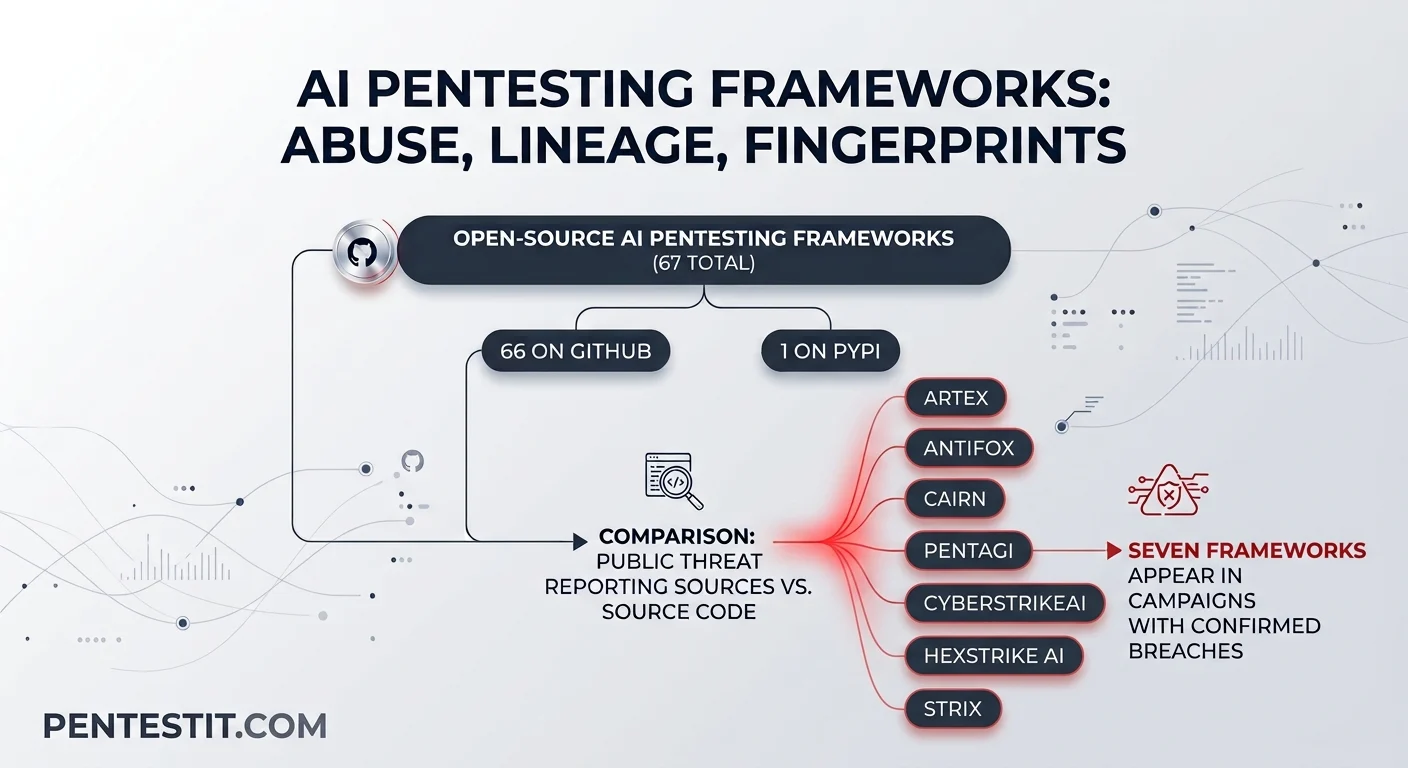
Seven of 67 open-source AI pentesting frameworks appear in breaches. In this post, I start by tracing ARTEX's code into a renamed copy and check fingerprints against the source code.
Read More -

Key Takeaways ARTEX, an open-source multi-agent penetration testing framework released on GitHub in July 2026, is a widely documented example of an openly published red-team tool being adopted as g…
Read More
Related rules
- Curl and Multiple HTTP Client Families from One External IP
- Web Server Cloud Metadata SSRF Request
- Web Server Potential Command Injection Request
- Web Server Potential SQL Injection Request
- Multiple Cloud Secrets Accessed by Source Address