Entra ID Microsoft Authentication Broker Sign-In with Non-Standard User Agent
Detects Microsoft Entra ID sign-in activity where the Microsoft Authentication Broker authenticates is using a user agent that is not consistent with common browser, mobile, or Windows platform authentication clients. Adversary-in-the-middle and OAuth phishing tooling often presents scripted or relayed user agents (for example Node.js, Python, or generic HTTP libraries) while still targeting first-party resources through the broker.
Elastic rule (View on GitHub)
  1[metadata]
  2creation_date = "2026/05/27"
  3integration = ["azure"]
  4maturity = "production"
  5updated_date = "2026/09/18"
  6
  7[rule]
  8author = ["Elastic"]
  9description = """
 10Detects Microsoft Entra ID sign-in activity where the Microsoft Authentication Broker authenticates is using a user agent
 11that is not consistent with common browser, mobile, or Windows platform authentication clients. Adversary-in-the-middle and OAuth phishing
 12tooling often presents scripted or relayed user agents (for example Node.js, Python, or generic HTTP libraries) while
 13still targeting first-party resources through the broker.
 14"""
 15false_positives = [
 16    """
 17    Legitimate automation, SDKs, or custom applications that obtain tokens through the Microsoft Authentication Broker
 18    against Graph, Azure AD, or Device Registration Service may use non-browser user agents. Baseline approved
 19    service principals, managed identities, and developer tooling before tuning exclusions for known automation
 20    patterns.
 21    """,
 22]
 23from = "now-9m"
 24index = ["logs-azure.signinlogs-*"]
 25language = "kuery"
 26license = "Elastic License v2"
 27name = "Entra ID Microsoft Authentication Broker Sign-In with Non-Standard User Agent"
 28note = """## Triage and analysis
 29
 30### Investigating Entra ID Microsoft Authentication Broker Sign-In with Non-Standard User Agent
 31
 32Review `azure.signinlogs.properties.user_principal_name`, `user_agent.original`,
 33`azure.signinlogs.properties.resource_display_name`, `azure.signinlogs.properties.session_id`, `source.ip`, and
 34`source.as.organization.name`.
 35
 36Confirm whether the user or application intentionally used a non-browser client against the requested resource.
 37
 38### Possible investigation steps
 39
 40- Inspect `user_agent.original` for automation libraries (for example `node`, `axios`, `python-requests`, `curl`).
 41- Correlate `azure.signinlogs.properties.session_id` with other sign-ins, device registration audit events, or Graph
 42  activity in the same time window.
 43- Review conditional access outcomes and identity protection signals for the user.
 44- Compare `source.ip` and ASN against expected VPN, MDM, and developer egress.
 45
 46### False positive analysis
 47
 48- Microsoft platform and mobile clients using Mozilla-, Dalvik-, CFNetwork-, or Windows-AzureAD-Authentication-Provider-
 49  style user agents are excluded by design.
 50- First-party CLI tools and test harnesses that legitimately broker tokens may still match if they use uncommon user
 51  agent strings.
 52
 53### Response and remediation
 54
 55- If malicious, revoke refresh tokens for the user, review newly registered devices, and reset credentials per policy.
 56- Escalate when paired with suspicious ASN sign-ins, multi-IP OAuth flows, or follow-on Graph data access.
 57"""
 58references = [
 59    "https://www.volexity.com/blog/2025/04/22/phishing-for-codes-russian-threat-actors-target-microsoft-365-oauth-workflows/",
 60    "https://dirkjanm.io/phishing-for-microsoft-entra-primary-refresh-tokens/",
 61    "https://any.run/malware-trends/tycoon/",
 62]
 63risk_score = 73
 64rule_id = "c22f89d9-b674-4650-8454-02242c8b35eb"
 65severity = "high"
 66setup = """
 67Microsoft Entra ID sign-in logs (`logs-azure.signinlogs-*`) must populate `user_agent.original`,
 68`azure.signinlogs.properties.app_display_name`, and `azure.signinlogs.properties.resource_display_name`.
 69"""
 70tags = [
 71    "Domain: Cloud",
 72    "Domain: Identity",
 73    "Data Source: Azure",
 74    "Data Source: Microsoft Entra ID",
 75    "Data Source: Microsoft Entra ID Sign-In Logs",
 76    "Use Case: Threat Detection",
 77    "Tactic: Initial Access",
 78    "Tactic: Credential Access",
 79    "Resources: Investigation Guide",
 80    "Noise: Low",
 81    "Performance: Normal",
 82    "Profile: Recommended",
 83    "Threat: AiTM Phishing",
 84    "Rule Type: Custom Query (KQL)",
 85    "Platform: Entra ID",
 86]
 87timestamp_override = "event.ingested"
 88type = "query"
 89
 90query = '''
 91data_stream.dataset:"azure.signinlogs" and event.action:"Sign-in activity" and event.outcome:(success or Success) and
 92(azure.signinlogs.properties.app_display_name:"Microsoft Authentication Broker" or azure.signinlogs.properties.app_id:"29d9ed98-a469-4536-ade2-f981bc1d605e") and
 93user_agent.original:(* and not (Mozilla* or Dalvik* or *CFNetwork* or Windows-AzureAD-Authentication-Provider* or Java*ThinkPad*)) and
 94azure.signinlogs.properties.resource_display_name:*
 95'''
 96
 97[rule.investigation_fields]
 98field_names = [
 99    "@timestamp",
100    "user.name",
101    "user_agent.original",
102    "source.ip",
103    "source.as.number",
104    "source.as.organization.name",
105    "source.geo.country_name",
106    "event.outcome",
107    "azure.signinlogs.properties.user_principal_name",
108    "azure.signinlogs.properties.session_id",
109    "azure.signinlogs.properties.app_display_name",
110    "azure.signinlogs.properties.app_id",
111    "azure.signinlogs.properties.resource_display_name",
112    "azure.signinlogs.properties.resource_id",
113    "azure.signinlogs.properties.authentication_protocol",
114    "azure.tenant_id",
115]
116
117[[rule.threat]]
118framework = "MITRE ATT&CK"
119
120[[rule.threat.technique]]
121id = "T1566"
122name = "Phishing"
123reference = "https://attack.mitre.org/techniques/T1566/"
124
125[[rule.threat.technique.subtechnique]]
126id = "T1566.002"
127name = "Spearphishing Link"
128reference = "https://attack.mitre.org/techniques/T1566/002/"
129
130[rule.threat.tactic]
131id = "TA0001"
132name = "Initial Access"
133reference = "https://attack.mitre.org/tactics/TA0001/"
134
135[[rule.threat]]
136framework = "MITRE ATT&CK"
137
138[[rule.threat.technique]]
139id = "T1078"
140name = "Valid Accounts"
141reference = "https://attack.mitre.org/techniques/T1078/"
142
143[[rule.threat.technique.subtechnique]]
144id = "T1078.004"
145name = "Cloud Accounts"
146reference = "https://attack.mitre.org/techniques/T1078/004/"
147
148[rule.threat.tactic]
149id = "TA0005"
150name = "Defense Evasion"
151reference = "https://attack.mitre.org/tactics/TA0005/"
152
153[[rule.threat]]
154framework = "MITRE ATT&CK"
155
156[[rule.threat.technique]]
157id = "T1539"
158name = "Steal Web Session Cookie"
159reference = "https://attack.mitre.org/techniques/T1539/"
160
161[rule.threat.tactic]
162id = "TA0006"
163name = "Credential Access"
164reference = "https://attack.mitre.org/tactics/TA0006/"
Triage and analysis
Investigating Entra ID Microsoft Authentication Broker Sign-In with Non-Standard User Agent
Review azure.signinlogs.properties.user_principal_name, user_agent.original,
azure.signinlogs.properties.resource_display_name, azure.signinlogs.properties.session_id, source.ip, and
source.as.organization.name.
Confirm whether the user or application intentionally used a non-browser client against the requested resource.
Possible investigation steps
- Inspect
user_agent.originalfor automation libraries (for examplenode,axios,python-requests,curl). - Correlate
azure.signinlogs.properties.session_idwith other sign-ins, device registration audit events, or Graph activity in the same time window. - Review conditional access outcomes and identity protection signals for the user.
- Compare
source.ipand ASN against expected VPN, MDM, and developer egress.
False positive analysis
- Microsoft platform and mobile clients using Mozilla-, Dalvik-, CFNetwork-, or Windows-AzureAD-Authentication-Provider- style user agents are excluded by design.
- First-party CLI tools and test harnesses that legitimately broker tokens may still match if they use uncommon user agent strings.
Response and remediation
- If malicious, revoke refresh tokens for the user, review newly registered devices, and reset credentials per policy.
- Escalate when paired with suspicious ASN sign-ins, multi-IP OAuth flows, or follow-on Graph data access.
References
-
Since early March 2025, Volexity has observed multiple suspected Russian threat actors conducting highly targeted social engineering operations aimed at gaining access to the Microsoft 365 (M365) accounts of targeted individuals. This activity comes on the heels of attacks Volexity reported on back in February 2025, where Russian threat actors were discovered targeting users and organizations through Device Code Authentication phishing...
Read More -

In Microsoft Entra ID (formerly Azure AD, in this blog referred to as “Azure AD”), there are different types of OAuth tokens. The most powerful token is a Primary Refresh Token, which is linked to a user’s device and can be used to sign in to any Entra ID connected application and web site. In phishing scenarios, especially those that abuse legit OAuth flows such as device code phishing, the resulting tokens are often less powerful tokens that are limited in scope or usage methods. In this blog, I will describe new techniques to phish directly for Primary Refresh Tokens, and in some scenarios also deploy passwordless credentials that comply with even the strictest MFA policies.
Read More -
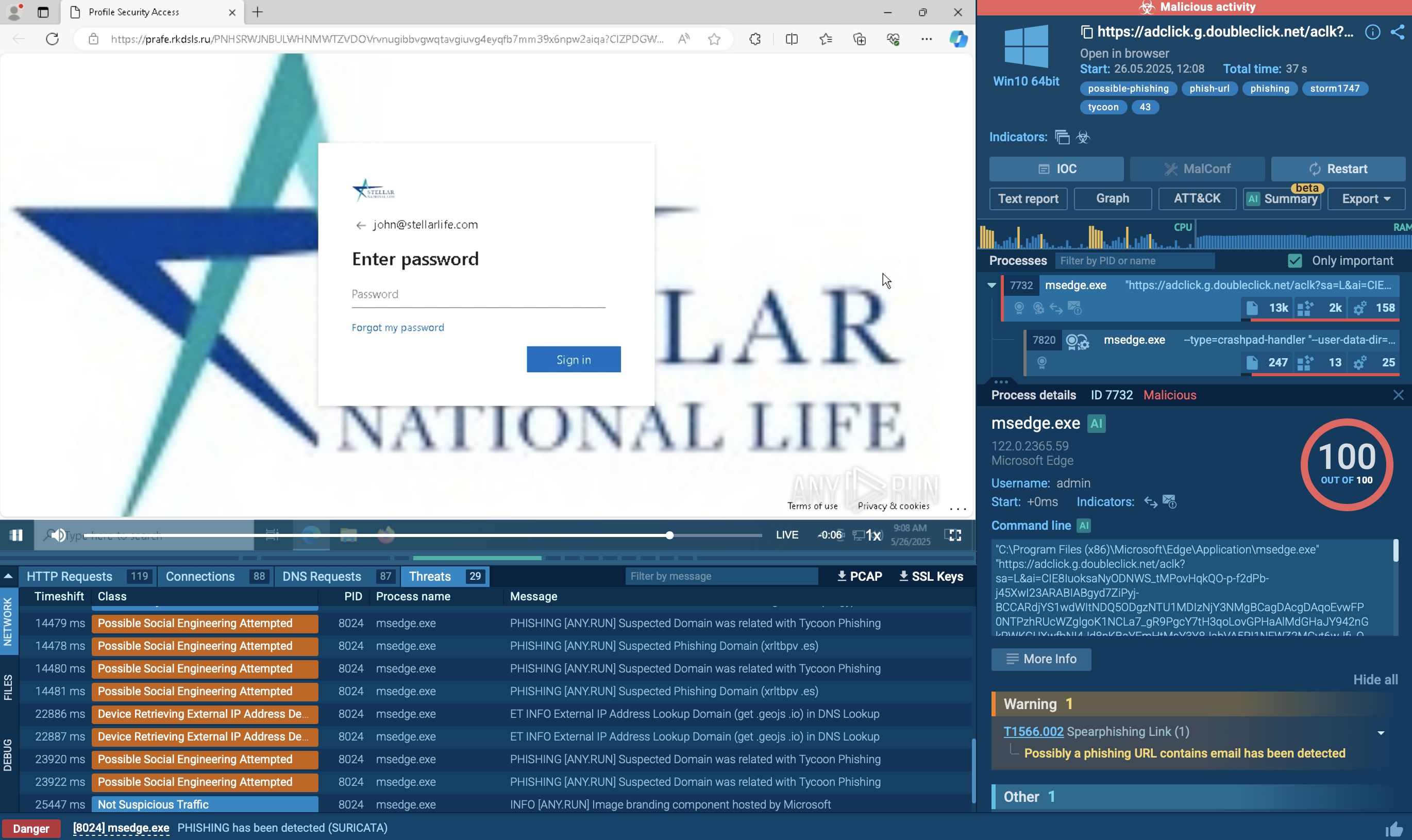
Tycoon 2FA is a phishing-as-a-service kit used for stealing credentials and equipped with advanced evasion capabilities.
Read More
Related rules
- Entra ID Kali365 Default User-Agent Detected
- Entra ID Microsoft Authentication Broker DRS Sign-In from Suspicious ASN
- Entra ID Microsoft Authentication Broker Sign-In to Unusual Resource
- Entra ID OAuth Device Code Phishing via AiTM
- Entra ID Potential AiTM Sign-In via OfficeHome (Tycoon2FA)