Entra ID Potential Passkey Downgrade
Identifies a Microsoft Entra ID user whose recent fresh authentications are predominantly phishing-resistant (passkey/FIDO2 or Windows Hello for Business) but who then successfully completes a phishable method such as Authenticator push, OATH, SMS, or voice. Adversary-in-the-middle proxies force this downgrade by suppressing the passkey prompt so the victim falls back to a relayable method. Legitimate fallback produces the same pattern, so the alert requires corroboration.
Elastic rule (View on GitHub)
  1[metadata]
  2creation_date = "2026/10/21"
  3integration = ["azure"]
  4maturity = "production"
  5min_stack_comments = "ES|QL support for the flattened field type (authentication_details) is in preview from 9.5."
  6min_stack_version = "9.5.0"
  7updated_date = "2026/11/18"
  8
  9[rule]
 10author = ["Elastic"]
 11description = """
 12Identifies a Microsoft Entra ID user whose recent fresh authentications are predominantly phishing-resistant
 13(passkey/FIDO2 or Windows Hello for Business) but who then successfully completes a phishable method such as
 14Authenticator push, OATH, SMS, or voice. Adversary-in-the-middle proxies force this downgrade by suppressing the passkey
 15prompt so the victim falls back to a relayable method. Legitimate fallback produces the same pattern, so the alert
 16requires corroboration.
 17"""
 18false_positives = [
 19    """
 20    A user who predominantly uses a passkey can legitimately fall back to a weaker method when their authenticator is
 21    unavailable (lost or forgotten security key, new or wiped device, biometric failure). Correlate the downgrade
 22    session's source IP, geo, ASN, user agent, device, and Conditional Access result with the user's norm, and confirm
 23    whether a help-desk or self-service recovery occurred. Only meaningful in environments with meaningful passkey
 24    adoption.
 25    """,
 26]
 27from = "now-5d"
 28interval = "15m"
 29language = "esql"
 30license = "Elastic License v2"
 31name = "Entra ID Potential Passkey Downgrade"
 32note = """## Triage and analysis
 33
 34### Investigating Entra ID Potential Passkey Downgrade
 35
 36This rule flags a user whose fresh authentications over the window are predominantly phishing-resistant (passkey/FIDO2 or Windows Hello for Business) but who then successfully completed authentication with a phishable method (Authenticator push, OATH, SMS, or voice) in the recent window. Each sign-in's `authentication_details` steps are paired with their `succeeded` flag, so only methods that actually succeeded are counted. The phishing-resistant ratio is computed over a baseline of sessions older than 24 hours (at least 3 resistant sessions required), so the recent downgrade cannot dilute it, and only over sessions with a successful fresh method (resistant plus phishable); sessions with only single sign-on token reuse (or whose establishing event is outside the window) are reported as unknown and excluded from the ratio rather than assumed to be passkey. Adversary-in-the-middle phishing can force this downgrade by suppressing the passkey prompt so the victim falls back to a relayable method the proxy can capture.
 37
 38### Possible investigation steps
 39
 40- Review the recent downgrade session(s) (`Esql.downgrade_sessions`, `Esql.downgrade_methods`, `Esql.downgrade_apps`, `Esql.downgrade_resources`): inspect `Esql.downgrade_user_agents` and `Esql.downgrade_device_os` for an unsupported/impossible browser-OS pairing, `Esql.downgrade_ips`/`Esql.downgrade_countries`/`Esql.downgrade_as_orgs` for hosting or VPS origins, and `Esql.downgrade_ca_status` for whether Conditional Access actually granted access.
 41- Confirm the user is genuinely passkey-preferring (`Esql.baseline_resistant`, `Esql.baseline_phishable`, `Esql.resistant_ratio`) rather than one who routinely mixes methods, and review `Esql.unknown_sessions` (token reuse / unresolved origin) separately.
 42- Correlate with recent authentication-method registration (a new passkey added nearby) and with device registration or PRT issuance for post-compromise persistence, and with subsequent `Previously satisfied` token reuse from a new ASN (stolen-session use).
 43
 44### False positive analysis
 45
 46- Legitimate fallback when a passkey authenticator is unavailable produces the same shape; validate device, network, and recovery workflow.
 47- A durable shift away from passkey lowers the resistant ratio over the window and stops qualifying.
 48
 49### Response and remediation
 50
 51- If unauthorized, treat the account as potentially compromised: revoke sessions and refresh tokens, remove any attacker-registered authentication methods or devices (delete devices first to break device-bound PRT persistence), and reset credentials.
 52- Enforce a phishing-resistant Conditional Access authentication strength so weaker methods cannot satisfy authentication.
 53"""
 54references = [
 55    "https://www.proofpoint.com/us/blog/threat-insight/dont-phish-let-me-down-fido-authentication-downgrade",
 56    "https://pushsecurity.com/blog/mfa-downgrade-attacks",
 57    "https://www.ioactive.com/authentication-downgrade-attacks-deep-dive-into-mfa-bypass/",
 58    "https://www.elastic.co/security-labs/entra-id-oauth-phishing-detection",
 59]
 60risk_score = 47
 61rule_id = "df328357-ebe0-4e51-94df-3bda9fa990f7"
 62setup = """#### Required Microsoft Entra ID Sign-In Logs
 63This rule requires the Azure integration with Microsoft Entra ID Sign-In logs enabled and collected via Azure Event Hub.
 64"""
 65severity = "medium"
 66tags = [
 67    "Domain: Cloud",
 68    "Domain: Identity",
 69    "Platform: Entra ID",
 70    "Platform: Azure",
 71    "Data Source: Entra ID Sign-In Logs",
 72    "Use Case: Identity and Access Audit",
 73    "Use Case: Threat Detection",
 74    "Tactic: Credential Access",
 75    "Threat: AiTM Phishing",
 76    "Rule Type: ES|QL",
 77    "Resources: Investigation Guide",
 78    "Profile: Beta",
 79]
 80timestamp_override = "event.ingested"
 81type = "esql"
 82
 83query = '''
 84FROM logs-azure.signinlogs-*
 85| WHERE azure.signinlogs.category == "SignInLogs"
 86    AND azure.signinlogs.properties.session_id IS NOT NULL
 87    AND azure.signinlogs.properties.authentication_details IS NOT NULL
 88    AND azure.signinlogs.properties.user_id IS NOT NULL
 89    AND azure.signinlogs.properties.user_principal_name IS NOT NULL
 90    AND azure.signinlogs.properties.tenant_id IS NOT NULL
 91
 92// Pair each authentication method with its success flag from the flattened authentication_details
 93| EVAL ad = TO_STRING(azure.signinlogs.properties.authentication_details)
 94| GROK ad """"authentication_method":%{DATA:method_raw},"authentication_"""
 95| GROK ad """"succeeded":%{DATA:succeeded_raw}}"""
 96| EVAL Esql.auth_methods = SPLIT(REPLACE(method_raw, """[\[\]"]""", ""), ","),
 97       Esql.auth_method_succeeded = SPLIT(REPLACE(succeeded_raw, """[\[\]"]""", ""), ",")
 98| EVAL Esql.method_outcome_pairs = MV_CONCAT(MV_ZIP(Esql.auth_methods, Esql.auth_method_succeeded, "~"), " || ")
 99
100// Flag sessions where a phishing-resistant or a phishable method actually succeeded (passkey/WHfB vs push/OATH/SMS/voice)
101| EVAL Esql.resistant_method_success = CASE(
102      Esql.method_outcome_pairs LIKE "*Passkey (synced)~true*" OR Esql.method_outcome_pairs LIKE "*Passkey (device-bound)~true*"
103      OR Esql.method_outcome_pairs LIKE "*FIDO2 security key~true*" OR Esql.method_outcome_pairs LIKE "*Windows Hello for Business~true*", 1, 0),
104    Esql.phishable_method_success = CASE(
105      Esql.method_outcome_pairs LIKE "*Mobile app notification~true*" OR Esql.method_outcome_pairs LIKE "*OATH verification code~true*"
106      OR Esql.method_outcome_pairs LIKE "*Text message~true*" OR Esql.method_outcome_pairs LIKE "*Voice call~true*", 1, 0)
107
108// A downgrade event is a phishable method succeeding within the recent window
109| EVAL Esql.is_downgrade = Esql.phishable_method_success == 1 AND @timestamp >= NOW() - 24 hour
110
111// Aggregate session counts and downgrade-event context by tenant and user
112| STATS Esql.total_sessions = COUNT_DISTINCT(azure.signinlogs.properties.session_id),
113        Esql.resistant_sessions = COUNT_DISTINCT(CASE(Esql.resistant_method_success == 1, azure.signinlogs.properties.session_id, null)),
114        Esql.phishable_sessions = COUNT_DISTINCT(CASE(Esql.phishable_method_success == 1, azure.signinlogs.properties.session_id, null)),
115        Esql.baseline_resistant = COUNT_DISTINCT(CASE(Esql.resistant_method_success == 1 AND @timestamp < NOW() - 24 hour, azure.signinlogs.properties.session_id, null)),
116        Esql.baseline_phishable = COUNT_DISTINCT(CASE(Esql.phishable_method_success == 1 AND @timestamp < NOW() - 24 hour, azure.signinlogs.properties.session_id, null)),
117        Esql.downgrade_session_count = COUNT_DISTINCT(CASE(Esql.is_downgrade, azure.signinlogs.properties.session_id, null)),
118        Esql.last_seen = MAX(@timestamp),
119        Esql.downgrade_methods = VALUES(CASE(Esql.is_downgrade, Esql.method_outcome_pairs, null)),
120        Esql.downgrade_sessions = VALUES(CASE(Esql.is_downgrade, azure.signinlogs.properties.session_id, null)),
121        Esql.downgrade_ips = VALUES(CASE(Esql.is_downgrade, source.ip, null)),
122        Esql.downgrade_as_orgs = VALUES(CASE(Esql.is_downgrade, source.`as`.organization.name, null)),
123        Esql.downgrade_countries = VALUES(CASE(Esql.is_downgrade, source.geo.country_name, null)),
124        Esql.downgrade_user_agents = VALUES(CASE(Esql.is_downgrade, user_agent.original, null)),
125        Esql.downgrade_device_os = VALUES(CASE(Esql.is_downgrade, azure.signinlogs.properties.device_detail.operating_system, null)),
126        Esql.downgrade_apps = VALUES(CASE(Esql.is_downgrade, azure.signinlogs.properties.app_display_name, null)),
127        Esql.downgrade_resources = VALUES(CASE(Esql.is_downgrade, azure.signinlogs.properties.resource_display_name, null)),
128        Esql.downgrade_client_apps = VALUES(CASE(Esql.is_downgrade, azure.signinlogs.properties.client_app_used, null)),
129        Esql.downgrade_ca_status = VALUES(CASE(Esql.is_downgrade, azure.signinlogs.properties.conditional_access_status, null)),
130        Esql.downgrade_risk_states = VALUES(CASE(Esql.is_downgrade, azure.signinlogs.properties.risk_state, null)),
131        Esql.downgrade_correlation_ids = VALUES(CASE(Esql.is_downgrade, azure.signinlogs.properties.correlation_id, null)),
132        Esql.downgrade_outcomes = VALUES(CASE(Esql.is_downgrade, event.outcome, null))
133    BY azure.signinlogs.properties.tenant_id, azure.signinlogs.properties.user_principal_name, azure.signinlogs.properties.user_id
134
135// Require a minimum resistant baseline (sessions older than 24h) and at least one recent downgrade
136| WHERE Esql.baseline_resistant >= 3 AND Esql.downgrade_session_count >= 1
137
138// Phishing-resistant ratio over the baseline only, so the downgrade session should not dilute it (token-reuse / unresolved sessions excluded)
139| EVAL Esql.unknown_sessions = Esql.total_sessions - Esql.phishable_sessions - Esql.resistant_sessions,
140       Esql.fresh_auth_sessions = Esql.resistant_sessions + Esql.phishable_sessions,
141       Esql.resistant_ratio = Esql.baseline_resistant::double / (Esql.baseline_resistant + Esql.baseline_phishable)
142
143// Keep predominantly phishing-resistant users (>= 90%)
144| WHERE Esql.resistant_ratio >= 0.9
145| KEEP azure.*, Esql.*
146'''
147
148
149[[rule.threat]]
150framework = "MITRE ATT&CK"
151[[rule.threat.technique]]
152id = "T1557"
153name = "Adversary-in-the-Middle"
154reference = "https://attack.mitre.org/techniques/T1557/"
155[[rule.threat.technique]]
156id = "T1556"
157name = "Modify Authentication Process"
158reference = "https://attack.mitre.org/techniques/T1556/"
159[[rule.threat.technique.subtechnique]]
160id = "T1556.006"
161name = "Multi-Factor Authentication"
162reference = "https://attack.mitre.org/techniques/T1556/006/"
163[rule.threat.tactic]
164id = "TA0006"
165name = "Credential Access"
166reference = "https://attack.mitre.org/tactics/TA0006/"
167
168[[rule.threat]]
169framework = "MITRE ATT&CK"
170[[rule.threat.technique]]
171id = "T1078"
172name = "Valid Accounts"
173reference = "https://attack.mitre.org/techniques/T1078/"
174[[rule.threat.technique.subtechnique]]
175id = "T1078.004"
176name = "Cloud Accounts"
177reference = "https://attack.mitre.org/techniques/T1078/004/"
178[rule.threat.tactic]
179id = "TA0001"
180name = "Initial Access"
181reference = "https://attack.mitre.org/tactics/TA0001/"
182
183[[rule.threat]]
184framework = "MITRE ATT&CK"
185[[rule.threat.technique]]
186id = "T1550"
187name = "Use Alternate Authentication Material"
188reference = "https://attack.mitre.org/techniques/T1550/"
189[[rule.threat.technique.subtechnique]]
190id = "T1550.004"
191name = "Web Session Cookie"
192reference = "https://attack.mitre.org/techniques/T1550/004/"
193[rule.threat.tactic]
194id = "TA0005"
195name = "Defense Evasion"
196reference = "https://attack.mitre.org/tactics/TA0005/"
197
198[rule.alert_suppression]
199group_by = ["azure.signinlogs.properties.user_id"]
200missing_fields_strategy = "suppress"
201
202[rule.alert_suppression.duration]
203unit = "h"
204value = 24
Triage and analysis
Investigating Entra ID Potential Passkey Downgrade
This rule flags a user whose fresh authentications over the window are predominantly phishing-resistant (passkey/FIDO2 or Windows Hello for Business) but who then successfully completed authentication with a phishable method (Authenticator push, OATH, SMS, or voice) in the recent window. Each sign-in's authentication_details steps are paired with their succeeded flag, so only methods that actually succeeded are counted. The phishing-resistant ratio is computed over a baseline of sessions older than 24 hours (at least 3 resistant sessions required), so the recent downgrade cannot dilute it, and only over sessions with a successful fresh method (resistant plus phishable); sessions with only single sign-on token reuse (or whose establishing event is outside the window) are reported as unknown and excluded from the ratio rather than assumed to be passkey. Adversary-in-the-middle phishing can force this downgrade by suppressing the passkey prompt so the victim falls back to a relayable method the proxy can capture.
Possible investigation steps
- Review the recent downgrade session(s) (
Esql.downgrade_sessions,Esql.downgrade_methods,Esql.downgrade_apps,Esql.downgrade_resources): inspectEsql.downgrade_user_agentsandEsql.downgrade_device_osfor an unsupported/impossible browser-OS pairing,Esql.downgrade_ips/Esql.downgrade_countries/Esql.downgrade_as_orgsfor hosting or VPS origins, andEsql.downgrade_ca_statusfor whether Conditional Access actually granted access. - Confirm the user is genuinely passkey-preferring (
Esql.baseline_resistant,Esql.baseline_phishable,Esql.resistant_ratio) rather than one who routinely mixes methods, and reviewEsql.unknown_sessions(token reuse / unresolved origin) separately. - Correlate with recent authentication-method registration (a new passkey added nearby) and with device registration or PRT issuance for post-compromise persistence, and with subsequent
Previously satisfiedtoken reuse from a new ASN (stolen-session use).
False positive analysis
- Legitimate fallback when a passkey authenticator is unavailable produces the same shape; validate device, network, and recovery workflow.
- A durable shift away from passkey lowers the resistant ratio over the window and stops qualifying.
Response and remediation
- If unauthorized, treat the account as potentially compromised: revoke sessions and refresh tokens, remove any attacker-registered authentication methods or devices (delete devices first to break device-bound PRT persistence), and reset credentials.
- Enforce a phishing-resistant Conditional Access authentication strength so weaker methods cannot satisfy authentication.
References
-

Key takeaways FIDO-based passkeys remain a highly recommended authentication method to protect against prevalent credential phishing and account takeover (ATO) threats.
Read More -
MFA downgrade attacks are an increasingly common technique used by attackers to bypass phishing-resistant authentication methods registered to an account.
Read More -
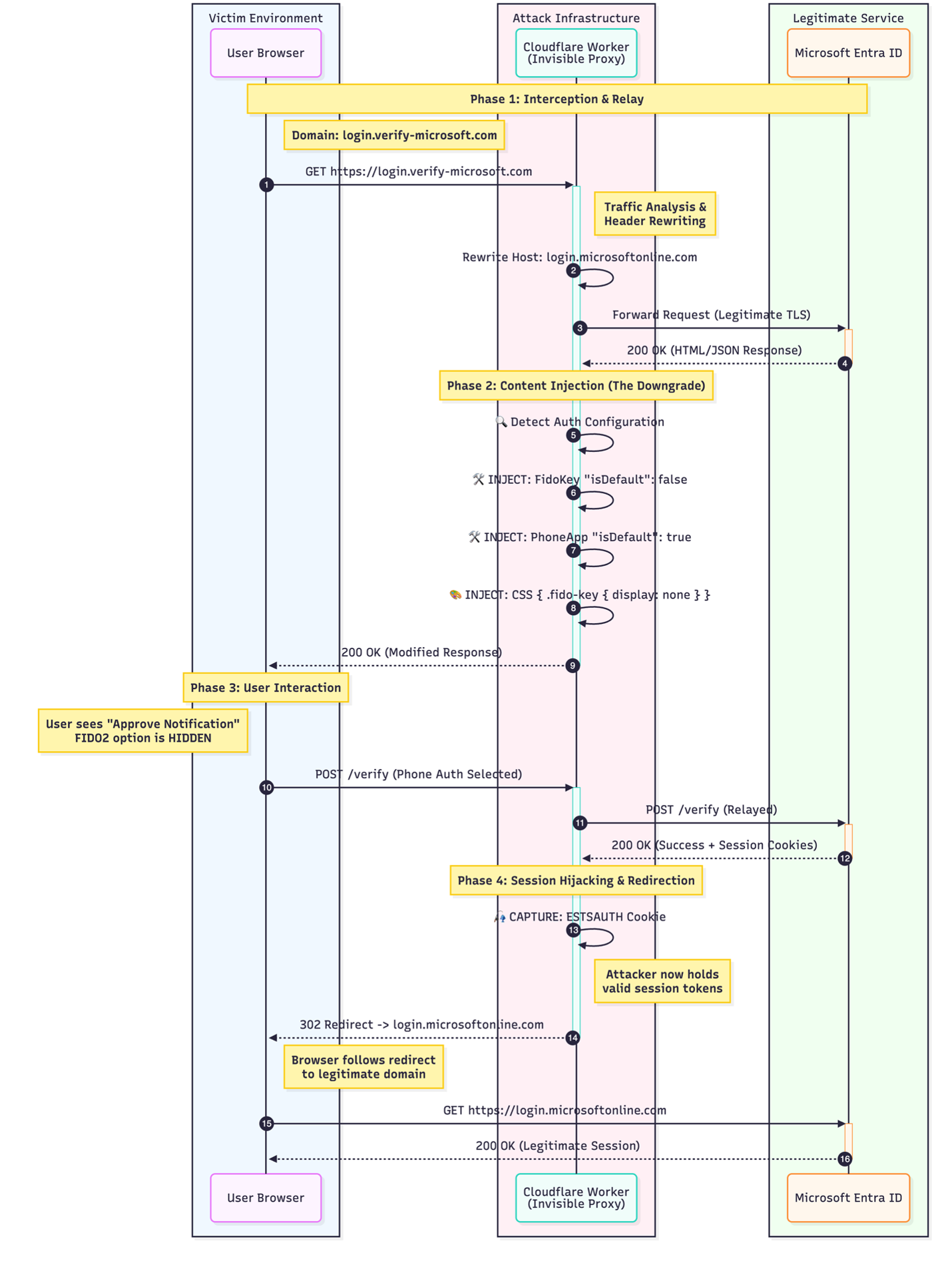
This research introduces two key contributions: first, the weaponization of Cloudflare Workers as a serverless transparent proxy platform that operates on trusted Content Delivery Network (CDN) infrastructure with zero forensic footprint; second, an Authentication Downgrade Attack technique that forces victims to fall back to phishable authentication methods (such as push notifications or OTPs) even when FIDO2 hardware keys are registered.
Read More -

This article explores OAuth phishing and token-based abuse in Microsoft Entra ID. Through emulation and analysis of tokens, scope, and device behavior during sign-in activity, we surface high-fidelity...
Read More
Related rules
- Entra ID Concurrent Sign-in with Suspicious Properties
- Entra ID MFA TOTP Brute Force Attempted
- Entra ID Sign-in Brute Force Attempted (Microsoft 365)
- Entra ID User Sign-in Brute Force Attempted
- Entra ID FIDO2 Passkey Registered Outside the Self-Service Portal