AWS STS Role Chaining
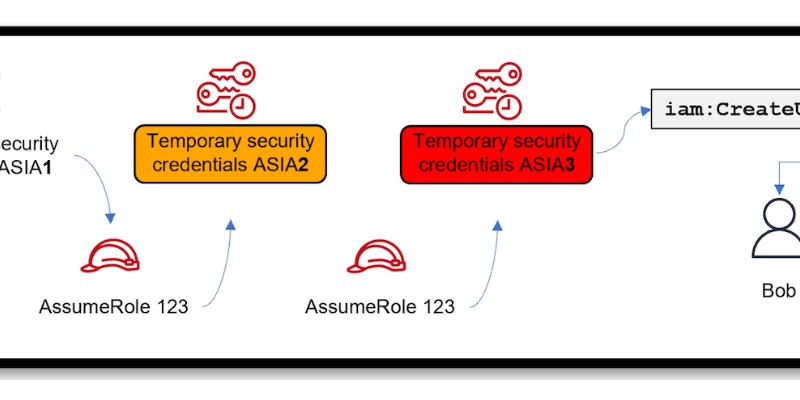
Identifies role chaining activity. Role chaining is when you use one assumed role to assume a second role through the AWS CLI or API. While this a recognized functionality in AWS, role chaining can be abused for privilege escalation if the subsequent assumed role provides additional privileges. Role chaining can also be used as a persistence mechanism as each AssumeRole action results in a refreshed session token with a 1 hour maximum duration. This is a new terms rule that looks for the first occurance of one role (aws.cloudtrail.user_identity.session_context.session_issuer.arn) assuming another (aws.cloudtrail.resources.arn).
Elastic rule (View on GitHub)
  1[metadata]
  2creation_date = "2024/10/23"
  3integration = ["aws"]
  4maturity = "production"
  5updated_date = "2026/09/18"
  6
  7[rule]
  8author = ["Elastic"]
  9description = """
 10Identifies role chaining activity. Role chaining is when you use one assumed role to assume a second role through the
 11AWS CLI or API. While this a recognized functionality in AWS, role chaining can be abused for privilege escalation if
 12the subsequent assumed role provides additional privileges. Role chaining can also be used as a persistence mechanism as
 13each AssumeRole action results in a refreshed session token with a 1 hour maximum duration. This is a new terms rule that looks for the first occurance of one role (aws.cloudtrail.user_identity.session_context.session_issuer.arn) assuming another (aws.cloudtrail.resources.arn).
 14"""
 15false_positives = [
 16    """
 17    Role chaining can be used as an access control. Ensure that this behavior is not part of a legitimate operation
 18    before taking action.
 19    """,
 20]
 21from = "now-6m"
 22index = ["filebeat-*", "logs-aws.cloudtrail-*"]
 23language = "kuery"
 24license = "Elastic License v2"
 25name = "AWS STS Role Chaining"
 26note = """
 27## Triage and analysis
 28
 29### Investigating AWS STS Role Chaining
 30
 31Role chaining occurs when a role assumed with temporary credentials (`AssumeRole`) is used to assume another role. While supported by AWS, chaining can increase risk of Privilege escalation, if the second role grants broader permissions; and Persistence, since each chained AssumeRole refreshes the session with up to 1-hour duration. This new terms rule triggers on the first observed combination of one role (`aws.cloudtrail.user_identity.session_context.session_issuer.arn`) assuming another (`aws.cloudtrail.resources.arn`).
 32
 33### Possible investigation steps
 34
 35- **Review Alert Context**: Investigate the alert, focusing on `aws.cloudtrail.user_identity.session_context.session_issuer.arn` (the calling role) and `aws.cloudtrail.resources.arn` (the target role).
 36
 37- **Determine scope and intent.** Check `aws.cloudtrail.recipient_account_id` and `aws.cloudtrail.resources.account_id` fields to identify whether the chaining is Intra-account (within the same AWS account) or Cross-account (from another AWS account).
 38
 39- **Check role privileges.** Compare policies of the calling and target roles. Determine if chaining increases permissions (for example, access to S3 data, IAM modifications, or admin privileges).
 40
 41- **Correlate with other activity.** Look for related alerts or CloudTrail activity within ±30 minutes: policy changes, unusual S3 access, or use of sensitive APIs. Use `aws.cloudtrail.user_identity.arn` to track behavior from the same role session, use `aws.cloudtrail.user_identity.session_context.session_issuer.arn` to track broader behavior from the role itself.
 42
 43- **Validate legitimacy.** Contact the account or service owner to confirm if the chaining was expected (for example, automation pipelines or federated access flows).
 44
 45- **Geography & source.** Review `cloud.region`, `source.address`, and other `geo` fields to assess if the activity originates from expected regions or network ranges.
 46
 47### False positive analysis
 48
 49- **Expected role chaining.** Some organizations use role chaining as part of multi-account access strategies. Maintain an allowlist of known `issuer.arn` - `target.arn` pairs.
 50- **Automation and scheduled tasks.** CI/CD systems or monitoring tools may assume roles frequently. Validate by `userAgent` and historical behavior.
 51- **Test/dev environments.** Development accounts may generate experimental chaining patterns. Tune rules or exceptions to exclude low-risk accounts.
 52
 53### Response and remediation
 54
 55**Immediate steps**
 56- **Preserve evidence.** Export triggering CloudTrail events (±30 minutes) into a restricted evidence bucket. Include session context, source IP, and user agent.
 57- **Notify owners.** Contact the owners of both roles to validate intent.
 58
 59**Containment (if suspicious)**
 60- **Revoke temporary credentials.** [Revoke Session Permissions](https://docs.aws.amazon.com/IAM/latest/UserGuide/id_roles_use_revoke-sessions.html) if possible, or attach [AWSDenyALL policy](https://docs.aws.amazon.com/aws-managed-policy/latest/reference/AWSDenyAll.html) to the originating role.
 61- **Restrict risky roles.** Apply least-privilege policies or temporarily deny `sts:AssumeRole` for suspicious principals.
 62- **Enable monitoring.** Ensure CloudTrail and GuardDuty are active in all regions to detect further chaining.
 63
 64**Scope and hunt**
 65- Search for additional AssumeRole activity by the same `issuer.arn` or `resources.arn` across other accounts and regions.
 66- Look for privilege escalation attempts (for example, IAM `AttachRolePolicy`, `UpdateAssumeRolePolicy`) or sensitive data access following the chain.
 67
 68**Recovery & hardening**
 69- Apply least privilege to all roles, limiting trust policies to only required principals.
 70- Enforce MFA where possible on AssumeRole operations.
 71- Periodically review role chaining patterns to validate necessity; remove unused or risky trust relationships.
 72- Document and tune new terms exceptions for known, legitimate chains.
 73
 74### Additional information
 75
 76- [AWS IR Playbooks](https://github.com/aws-samples/aws-incident-response-playbooks/): NIST-aligned templates for evidence, containment, eradication, recovery, post-incident.
 77- [AWS Customer Playbook Framework](https://github.com/aws-samples/aws-customer-playbook-framework/): Practical response steps for account and IAM misuse scenarios
 78- AWS IAM Best Practices: [AWS docs](https://docs.aws.amazon.com/IAM/latest/UserGuide/best-practices.html) for reducing risk from temporary credentials.
 79
 80## Setup
 81
 82The AWS Fleet integration, Filebeat module, or similarly structured data is required to be compatible with this rule.
 83"""
 84references = [
 85    "https://docs.aws.amazon.com/IAM/latest/UserGuide/id_roles.html#id_roles_terms-and-concepts",
 86    "https://www.uptycs.com/blog/detecting-anomalous-aws-sessions-temporary-credentials",
 87    "https://hackingthe.cloud/aws/post_exploitation/role-chain-juggling/",
 88]
 89risk_score = 47
 90rule_id = "ba5a0b0c-b477-4729-a3dc-0147c2049cf1"
 91severity = "medium"
 92tags = [
 93    "Domain: Cloud",
 94    "Data Source: AWS",
 95    "Data Source: Amazon Web Services",
 96    "Data Source: AWS STS",
 97    "Use Case: Threat Detection",
 98    "Tactic: Persistence",
 99    "Tactic: Privilege Escalation",
100    "Tactic: Lateral Movement",
101    "Resources: Investigation Guide",
102    "Noise: High",
103    "Performance: Normal",
104    "Profile: Aggressive",
105    "Rule Type: New Terms",
106    "Platform: AWS",
107    "Data Source: AWS CloudTrail",
108    "Service: AWS STS",
109]
110timestamp_override = "event.ingested"
111type = "new_terms"
112
113query = '''
114    data_stream.dataset : "aws.cloudtrail" and
115    event.provider : "sts.amazonaws.com" and
116    event.action : "AssumeRole" and
117    aws.cloudtrail.user_identity.type : "AssumedRole" and
118    event.outcome : "success"
119'''
120
121[rule.investigation_fields]
122field_names = [
123    "@timestamp",
124    "user_agent.original",
125    "source.ip",
126    "user.name",
127    "aws.cloudtrail.user_identity.session_context.session_issuer.arn",
128    "aws.cloudtrail.user_identity.arn",
129    "aws.cloudtrail.user_identity.type",
130    "aws.cloudtrail.user_identity.access_key_id",
131    "aws.cloudtrail.resources.arn",
132    "aws.cloudtrail.resources.type",
133    "event.action",
134    "event.outcome",
135    "aws.cloudtrail.recipient_account_id",
136    "aws.cloudtrail.resources.account_id",
137    "cloud.region",
138    "aws.cloudtrail.request_parameters",
139    "aws.cloudtrail.response_elements"
140]
141
142[[rule.threat]]
143framework = "MITRE ATT&CK"
144
145[[rule.threat.technique]]
146id = "T1078"
147name = "Valid Accounts"
148reference = "https://attack.mitre.org/techniques/T1078/"
149
150[[rule.threat.technique.subtechnique]]
151id = "T1078.004"
152name = "Cloud Accounts"
153reference = "https://attack.mitre.org/techniques/T1078/004/"
154
155[[rule.threat.technique]]
156id = "T1548"
157name = "Abuse Elevation Control Mechanism"
158reference = "https://attack.mitre.org/techniques/T1548/"
159
160[rule.threat.tactic]
161id = "TA0004"
162name = "Privilege Escalation"
163reference = "https://attack.mitre.org/tactics/TA0004/"
164
165[[rule.threat]]
166framework = "MITRE ATT&CK"
167
168[[rule.threat.technique]]
169id = "T1550"
170name = "Use Alternate Authentication Material"
171reference = "https://attack.mitre.org/techniques/T1550/"
172
173[[rule.threat.technique.subtechnique]]
174id = "T1550.001"
175name = "Application Access Token"
176reference = "https://attack.mitre.org/techniques/T1550/001/"
177
178[rule.threat.tactic]
179id = "TA0008"
180name = "Lateral Movement"
181reference = "https://attack.mitre.org/tactics/TA0008/"
182
183[[rule.threat]]
184framework = "MITRE ATT&CK"
185
186[[rule.threat.technique]]
187id = "T1078"
188name = "Valid Accounts"
189reference = "https://attack.mitre.org/techniques/T1078/"
190
191[[rule.threat.technique.subtechnique]]
192id = "T1078.004"
193name = "Cloud Accounts"
194reference = "https://attack.mitre.org/techniques/T1078/004/"
195
196[rule.threat.tactic]
197id = "TA0003"
198name = "Persistence"
199reference = "https://attack.mitre.org/tactics/TA0003/"
200[rule.new_terms]
201field = "new_terms_fields"
202value = ["aws.cloudtrail.user_identity.session_context.session_issuer.arn", "aws.cloudtrail.resources.arn"]
203[[rule.new_terms.history_window_start]]
204field = "history_window_start"
205value = "now-10d"
Triage and analysis
Investigating AWS STS Role Chaining
Role chaining occurs when a role assumed with temporary credentials (AssumeRole) is used to assume another role. While supported by AWS, chaining can increase risk of Privilege escalation, if the second role grants broader permissions; and Persistence, since each chained AssumeRole refreshes the session with up to 1-hour duration. This new terms rule triggers on the first observed combination of one role (aws.cloudtrail.user_identity.session_context.session_issuer.arn) assuming another (aws.cloudtrail.resources.arn).
Possible investigation steps
-
Review Alert Context: Investigate the alert, focusing on
aws.cloudtrail.user_identity.session_context.session_issuer.arn(the calling role) andaws.cloudtrail.resources.arn(the target role). -
Determine scope and intent. Check
aws.cloudtrail.recipient_account_idandaws.cloudtrail.resources.account_idfields to identify whether the chaining is Intra-account (within the same AWS account) or Cross-account (from another AWS account). -
Check role privileges. Compare policies of the calling and target roles. Determine if chaining increases permissions (for example, access to S3 data, IAM modifications, or admin privileges).
-
Correlate with other activity. Look for related alerts or CloudTrail activity within ±30 minutes: policy changes, unusual S3 access, or use of sensitive APIs. Use
aws.cloudtrail.user_identity.arnto track behavior from the same role session, useaws.cloudtrail.user_identity.session_context.session_issuer.arnto track broader behavior from the role itself. -
Validate legitimacy. Contact the account or service owner to confirm if the chaining was expected (for example, automation pipelines or federated access flows).
-
Geography & source. Review
cloud.region,source.address, and othergeofields to assess if the activity originates from expected regions or network ranges.
False positive analysis
- Expected role chaining. Some organizations use role chaining as part of multi-account access strategies. Maintain an allowlist of known
issuer.arn-target.arnpairs. - Automation and scheduled tasks. CI/CD systems or monitoring tools may assume roles frequently. Validate by
userAgentand historical behavior. - Test/dev environments. Development accounts may generate experimental chaining patterns. Tune rules or exceptions to exclude low-risk accounts.
Response and remediation
Immediate steps
- Preserve evidence. Export triggering CloudTrail events (±30 minutes) into a restricted evidence bucket. Include session context, source IP, and user agent.
- Notify owners. Contact the owners of both roles to validate intent.
Containment (if suspicious)
- Revoke temporary credentials. Revoke Session Permissions if possible, or attach AWSDenyALL policy to the originating role.
- Restrict risky roles. Apply least-privilege policies or temporarily deny
sts:AssumeRolefor suspicious principals. - Enable monitoring. Ensure CloudTrail and GuardDuty are active in all regions to detect further chaining.
Scope and hunt
- Search for additional AssumeRole activity by the same
issuer.arnorresources.arnacross other accounts and regions. - Look for privilege escalation attempts (for example, IAM
AttachRolePolicy,UpdateAssumeRolePolicy) or sensitive data access following the chain.
Recovery & hardening
- Apply least privilege to all roles, limiting trust policies to only required principals.
- Enforce MFA where possible on AssumeRole operations.
- Periodically review role chaining patterns to validate necessity; remove unused or risky trust relationships.
- Document and tune new terms exceptions for known, legitimate chains.
Additional information
- AWS IR Playbooks: NIST-aligned templates for evidence, containment, eradication, recovery, post-incident.
- AWS Customer Playbook Framework: Practical response steps for account and IAM misuse scenarios
- AWS IAM Best Practices: AWS docs for reducing risk from temporary credentials.
Setup
The AWS Fleet integration, Filebeat module, or similarly structured data is required to be compatible with this rule.
References
-
-
Learn about short-term access keys (unofficially also known as temporary tokens or temporary credentials) in AWS, and how they can be compromised.
Read More -

Related rules
- AWS STS Role Assumption by Service
- AWS STS AssumeRole with New MFA Device
- AWS First Occurrence of STS GetFederationToken Request by User
- AWS IAM API Calls via Temporary Session Tokens
- AWS Lateral Movement from Kubernetes SA via AssumeRoleWithWebIdentity